Co-developed by bioMérieux and Mérieux NutriSciences, with industry partners.
Despite strong efforts, the food industry continues to cope with numerous safety and quality issues leading to public health threats, recalls and operational impacts. Changing the status quo and enhancing food safety control systems necessitates looking beyond the current systems based primarily on auditing, certification and testing.
This is why, together with some of the largest global food industry players, bioMérieux and Mérieux NutriSciences have developed an innovative and collaborative data-driven model where both companies jointly act as a Trusted Third Party.
Through our Trusted Third Party model, data is confidentially and securely aggregated* from all participating partners and is combined with other publicly available data of interest (commodity pricing, food safety alerts, weather anomalies, agriculture practices…) to:
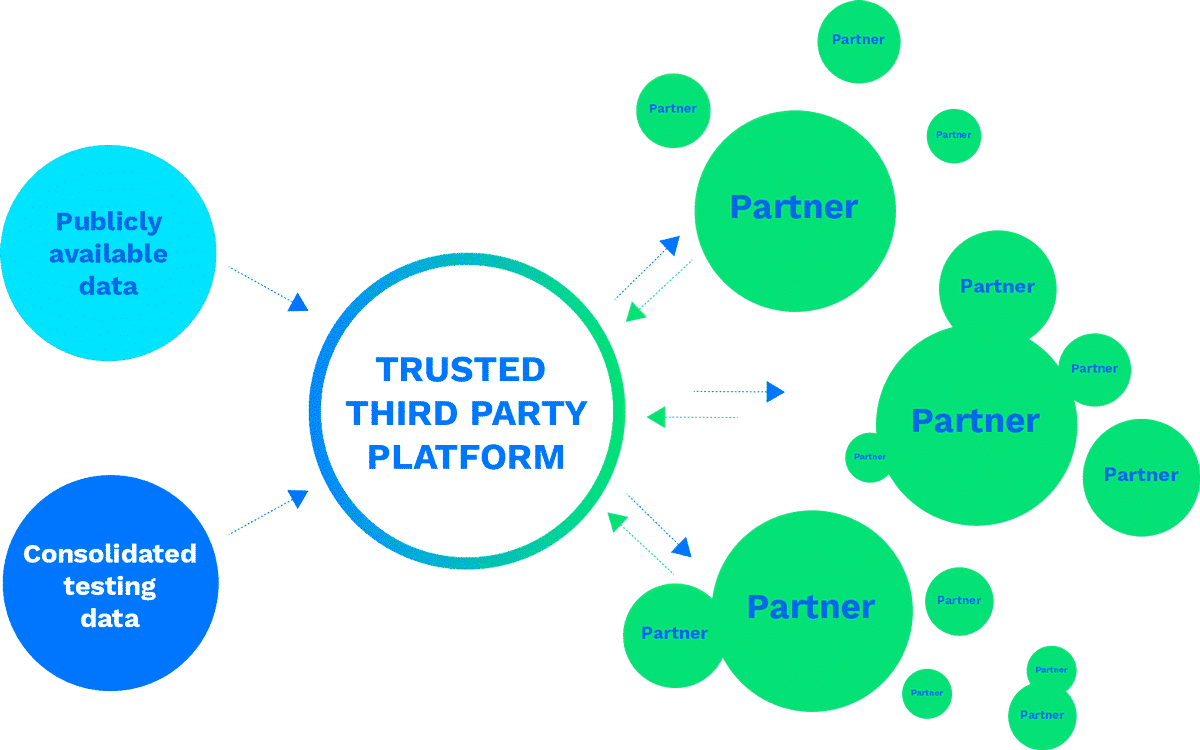
- Deliver consolidated anonymous insights
- Support business-critical decision-making
- Strengthen food safety risk management programs
- Reinforce supply chain integrity
- Promote competitiveness among industry players to reach higher quality and safety standards
*bioMérieux and Mérieux NutriSciences alone have access to all data sources.
Our Approach

The Trusted Third Party model has the potential to serve many applications, hence we have a broad and robust long-term ambition while delivering value progressively, starting with Supplier Risk.
Through consultation with our 6 early partners (Barry Callebaut; Danone; Mars; Mondelēz International; Nestlé; PepsiCo), we have designed the model based on 5 key business questions:
- Overall trends understanding ⇒ How is current global supply vs historical performance?
- Earlier risk identification ⇒ Can I have a deeper analysis of trends vs historical performance (per product, geography, analyte)?
- Better risk management ⇒ How do my supply trends compare to others?
- Testing plan adaptation ⇒ How does my testing plan compare to others?
- Risk anticipation ⇒ How can I identify external factors that make an impact on risk profiles?
Starting with 1 raw material commodity (shelf-stable milk products) and data source (chemical contaminants), we are upscaling our Trusted Third Party model by continuously adding new data (other raw material commodities; data sources) and onboarding new customers
As food industry is in reality more a small data world due to numerous different business segments, part of the value lies in the contextualization of data and insights. Hence we offer a recurring services delivery model based on an automated data analytics platform and applied expertise for bespoke analysis.
Responsible and collaborative use of data means seizing the opportunity to protect consumers, reduce food waste and create significant shared value.
Platform Example: Test Plan Benchmark Drill-down
Am I testing the “right” things? Am I testing enough/ too much?
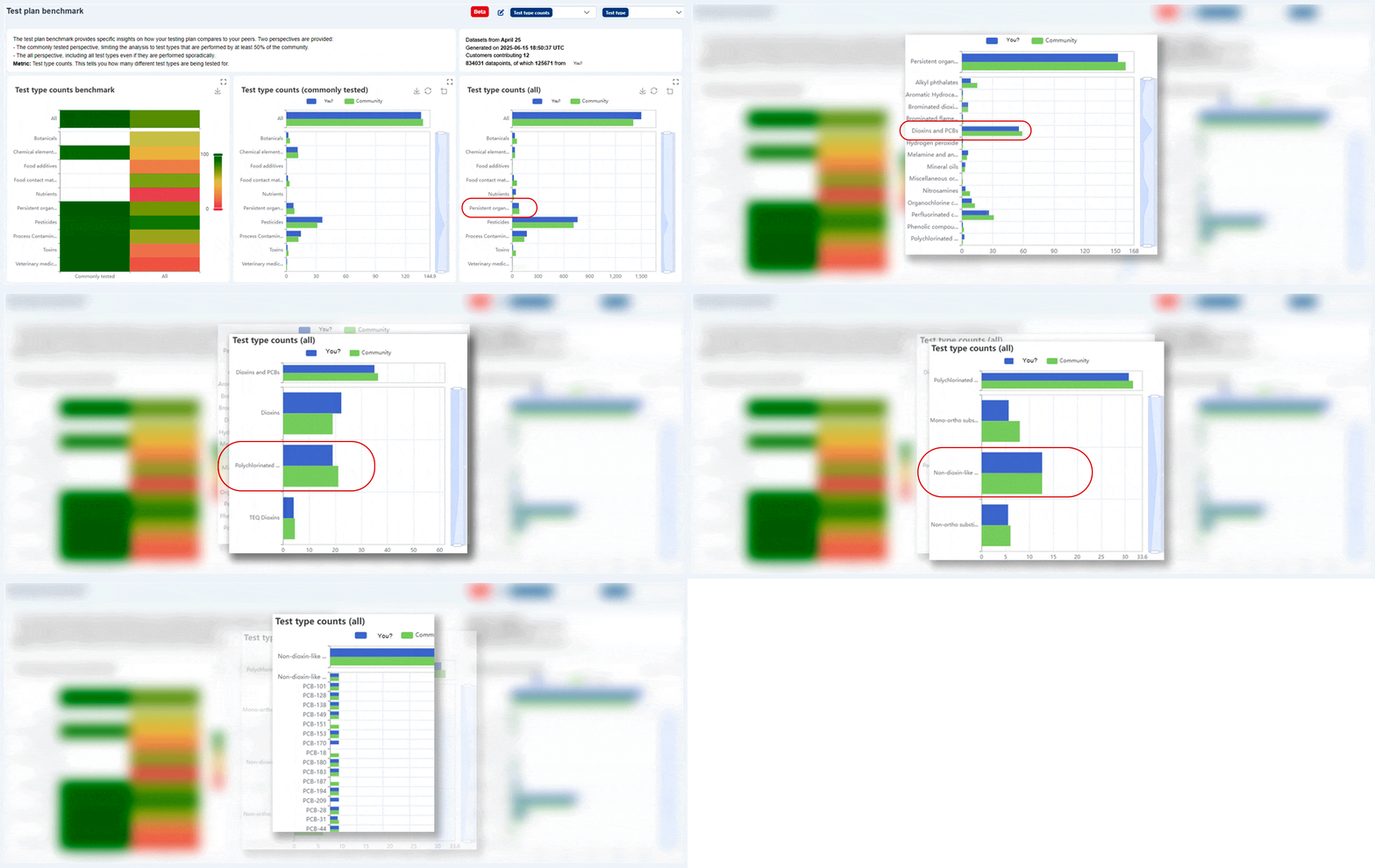
Note: The example above uses nonsensical data for demonstration purposes only. It does not reflect real data within the platform.
Platform Example: Product Quality
What’s good and what’s not so good in the current supply? How does the raw material risk profile change?
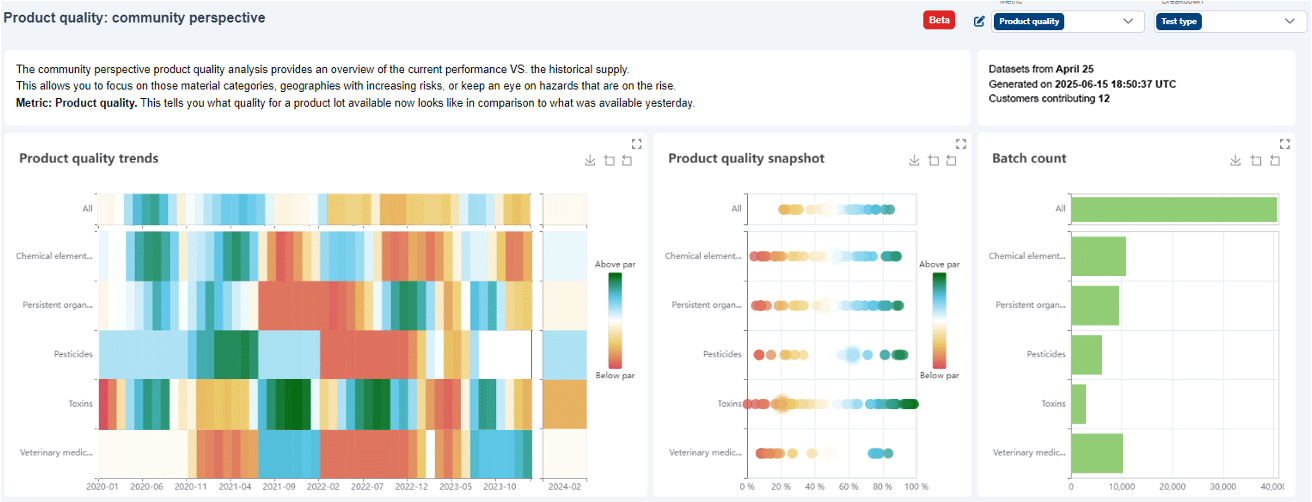
Note: The example above uses nonsensical data for demonstration purposes only. It does not reflect real data within the platform.
A few of our partners

How to Become a Trusted Third Party Partner
Our partners commit to:
Are you ready to change the game with us?
Find out more about becoming a partner by completing the form below: