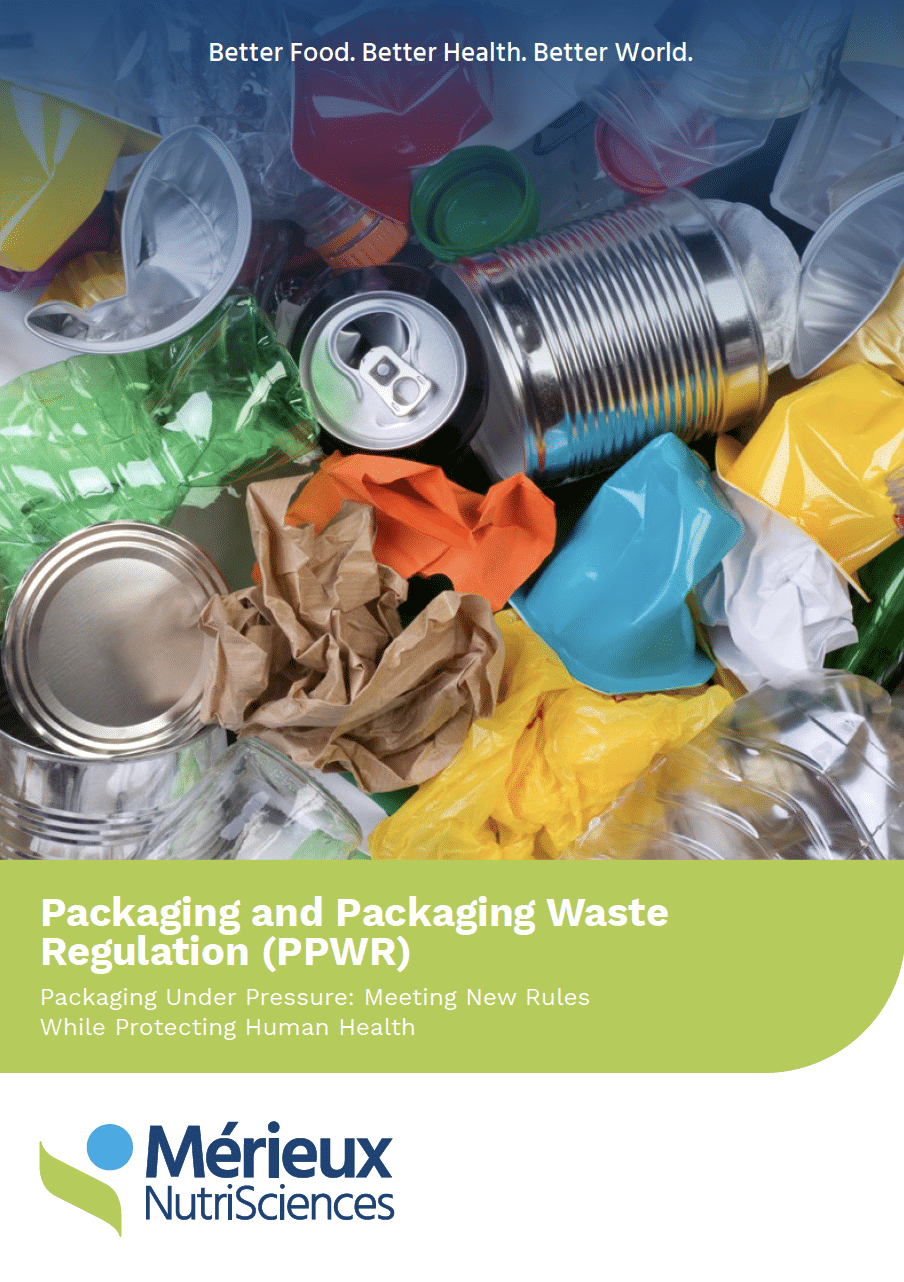
Ensure full compliance with the new PPWR regulation through our expert technical eco-design assessments and packaging recyclability analyses. Our specialists guide your business through volume reduction initiatives and recycled content certifications. We help you meet mandatory EU targets while transforming regulatory compliance into a strategic competitive advantage.
The Packaging and Packaging Waste Regulation (PPWR) is the new EU framework governing packaging across its entire life cycle. Its core objectives are to minimize waste, increase recycled content, and harmonize regulatory standards across all EU Member States. For packaging manufacturers and corporate users, this mandate requires balancing sustainability with strict safety protocols.
Mérieux NutriSciences supports companies in verifying data and adapting to these new requirements, ensuring robust regulatory compliance and the protection of consumer health.
Strategic PPWR Compliance Check
Through rigorous technical and regulatory analysis, we identify compliance gaps regarding current and future obligations, including recyclability, recycled content thresholds, restricted substances, and environmental labeling rules. We deliver a detailed risk assessment utilizing a clear traffic-light evaluation system to establish action priorities. This proactive approach allows you to anticipate critical vulnerabilities, ensuring market compliance, safety, and competitiveness within the EU.
Packaging Declaration of Conformity (DoC) Support
Beginning August 12th 2026, the PPWR regulation mandates that every type of packaging on the European Union market must possess its own official Declaration of Conformity (DoC). Our dedicated team assists companies in compiling these mandatory declarations and technical documentation files. We ensure full alignment not only with incoming PPWR requirements but also with overlapping packaging regulations enforced across the EU and other relevant global geographies.
Per- and polyfluoroalkyl substances (PFAS) present significant environmental challenges and consumer safety concerns. While the PPWR stops short of an outright total ban, the regulation actively harmonizes PFAS restriction rules for packaging across all EU Member States. The framework establishes precise concentration thresholds for PFAS, evaluating both total PFAS content and individual PFAS substances.
Our analytical laboratories provide specialized guidance on PFAS testing, deploying targeted testing methodologies for your specific materials while helping you mitigate non-conforming results.
Packaging Recyclability Certification & Testing
Mérieux NutriSciences is officially recognized and approved by RecyClass as an accredited Recyclability Certification Body for plastics.
Additionally, our facilities operate as a qualified, expert laboratory for performing specialized paper recyclability testing.
Safety & Contaminant Testing for Recycled Packaging
Integrating recycled materials into packaging configurations increases the risk of unexpected chemical migration. To protect your supply chain, we conduct exhaustive NIAS (Non-Intentionally Added Substances) screenings, migration tests, and structural verifications of functional barrier effectiveness. We provide comprehensive risk assessments and technical consulting to guarantee the absolute safety and regulatory compliance of all materials containing recycled content.
Certified Compostable Packaging Testing
We support businesses in testing specific packaging materials that must be compostable under new PPWR rules, such as permeable pouches and coffee capsules. For over 20 years, our team has executed comprehensive industrial and home compostability studies alongside functional shelf-life verifications.
Packaging Minimization & Optimization Assessments
We assist manufacturers in executing packaging minimization strategies by conducting physical-mechanical resistance testing and structural thickness verifications. Our experts accurately evaluate how reductions in total packaging weight and volume impact material barrier properties and product shelf life. This testing helps you identify the ideal equilibrium between physical performance, compliance with empty-space regulatory limits, and functional design.
Environmental Labeling Compliance & Green Claims
Our regulatory experts support companies adapting to both national and harmonized EU environmental labeling mandates. We provide robust validation of green claims through objective laboratory testing, independent verifications, and comprehensive Life Cycle Assessment (LCA) studies.
We guide organizations through the verification of reusable packaging systems. Our laboratories conduct rigorous testing regimes to validate hygiene, toxicological safety, and structural performance retention across successive, repeated operational use cycles.
What is the primary purpose of the EU PPWR regulation?
The Packaging and Packaging Waste Regulation (PPWR) is a new EU-wide regulation designed to manage packaging throughout its entire life cycle. Its main objectives are to systematically reduce packaging waste, mandate higher levels of recycled content, and fully harmonize packaging compliance rules across all EU Member States.
When does the Packaging Declaration of Conformity (DoC) become mandatory?
Beginning August 12th, the PPWR regulation dictates that every single type of packaging placed on the European Union market will be legally required to possess its own official Declaration of Conformity (DoC) alongside its mandatory supporting technical documentation.
Does the PPWR completely ban PFAS in packaging?
No, the PPWR regulation does not implement a total, blanket ban on PFAS. Instead, the framework is structured to harmonize conflicting PFAS rules in packaging across all member states. It achieves this by establishing specific concentration thresholds for the presence of PFAS, taking into account both the total overall PFAS content and individual chemical substances.
What are the safety risks associated with recycled packaging materials?
When packaging configurations incorporate recycled content, the underlying risk of encountering unexpected chemical contaminants increases significantly. To guarantee consumer safety and regulatory compliance, companies must perform targeted NIAS (Non-Intentionally Added Substances) screenings, migration tests, and strict verifications of functional barrier effectiveness.
Which packaging materials are required to be compostable under the new rules?
The PPWR specifies that certain packaging formats must be fully compostable to remain on the market. This mandate applies specifically to items such as permeable pouches and coffee or tea capsules.
How does packaging minimization impact product shelf life?
While reducing packaging weight and volume is mandatory to comply with empty-space limits, altering the thickness can directly impact the material’s barrier properties. Performance testing—such as physical-mechanical resistance testing and thickness verifications—is required to safely minimize packaging without compromising product shelf life or functional safety.