Per- and Polyfluoroalkyl Substances (PFASs), hydrophobic and lipophobic fluorinated compounds, find widespread use across various sectors:
Stain- and water-resistant coatings for fabrics and carpets.
Oil-resistant coatings for food-contact paper products (cookie sheets, food paper, fast food packaging, popcorn bags, etc.).
Fire-fighting foams, mining and oil well surfactants, floor polishes, and insecticide formulations.
Perfluorooctanesulfonic acid (PFOS) and Perfluorooctanoic acid (PFOA) are notable PFASs, categorized as (per)fluorinated organic surfactants and recognized as endocrine disruptors.
Health Risks & Environmental Impact
Evidence suggests their potential health hazards, with PFOA classified as a Group 2B carcinogen by the IARC, indicating probable carcinogenicity in animals and possible carcinogenicity in humans.
PFAS contamination, a pressing concern due to their persistence in the environment, remains a global issue. These compounds endure without degrading when exposed to air, water, or sunlight, allowing them to spread over long distances and accumulate in organisms, including humans.
PFAS Contamination Pathways
Because of chemical stability they can run long distances through the air, thus contaminating sites far away from the production plants and affecting living organisms where they may bioaccumulate.
The aquatic environment faces significant PFAS contamination, as seen in Italy’s 2013 PFAS alert, attributed to industrial discharges. PFASs’ presence in water sources underscores the need for thorough research to assess human health risks.
PFAS-related environmental pollution is the main cause of food contamination, which is in turn the main vehicle for human exposure to PFASs.
Food packaging and cookware can also introduce PFAS contamination into food. Studies have verified the presence of PFASs in food packaging, particularly in fast food containers requiring oil-resistant coatings.
Growing Concerns & Awareness
The prevalence of PFAS contamination in water, food, and food packaging raises significant concerns among consumers, especially since comprehensive scientific studies assessing potential health risks are still ongoing.
Despite the ongoing research and the absence of unified legislation, global awareness of PFAS risks continues to grow:
The list of POPs – Persistent Organic Pollutants – includes PFOS, PFOA, PFHxS, related salts and derivatives.
On 9 July 2020, the European Food Safety Authority (EFSA) adopted an opinion on the risk to human health related to the presence of perfluoroalkyl substances in food. EFSA concluded that PFOS, PFOA, PFNA, and PFHxS can cause developmental effects and may have adverse effects on serum cholesterol, the liver, the immune system, and birth weight. It considered the effects on the immune system the most critical and established a group tolerable weekly intake (TWI) of 4.4 ng/kg body weight per week for the sum of PFOS, PFOA, PFNA, and PFHxS, which is also protective against the other effects of those substances. It concluded that the exposure of parts of the European population to those substances exceeds the TWI, which is of concern.
In February 2023, five EU Member States proposed a restriction aiming to ban the manufacture, use, and placing on the market of over 10,000 PFAS, which is currently under evaluation by ECHA’s scientific committees.
Mérieux NutriSciences offers comprehensive analysis services for PFAS in food, water, and food packaging using various technical approaches, including advanced LC/ESI-MS/MS methods. Compliance with local regulations ensures accurate and reliable results.
PFAS in Food & Food Packaging
For PFAS in food and food packaging, Mérieux NutriSciences utilizes specific isotopically-labeled standards for each PFAS analyzed, adhering to quantification limits that comply with guidelines and national laws.
PFAS in Food
In 2022, the European Commission took a position on food safety by introducing legal limits for certain PFAS in specific foods, particularly foods of animal origin (meat, edible offal, game animals, eggs, and egg products) as well as food intended for infants and young children. In 2023, these limits were incorporated into Commission Regulation (EU) 2023/915.
Additionally, on 26 August 2022, the European Commission published Recommendation (EU) 2022/1431 on the monitoring of perfluoroalkyl substances in certain foodstuffs. It recommended that Member States monitor the presence of PFAS in food between 2022 and 2025, especially in fruits, vegetables, starchy roots and tubers, seaweed, cereals, nuts, oilseeds, food for infants and young children, baby food, milk, molluscs, wild fungi, fish oil, foods of animal origin, non-alcoholic drinks, wine, and beer.
PFAS in Food Packaging
PFAS in food packaging have not been addressed in a harmonized way worldwide. However, starting in 2025, the Packaging and Packaging Waste Regulation (PPWR) in Europe will include limits for PFAS in food contact materials. The regulation sets the following limits:
25 ppb for a single target PFAS;
250 ppb for the sum of measured target PFAS, including those deriving from precursors;
50 ppm for total PFAS, including polymeric compounds (measured as total fluorine).
PFAS in Water
Mérieux Nutrisciences analyses PFAS with international and in-house methods in water for human use, process water, and groundwater.
For drinking water, the harmonized reference in Europe is Directive 2020/2184, which includes PFAS. Mérieux NutriSciences has developed specific testing profiles for water intended for human consumption, in line with the requirements of this legislation.
It is also possible to add to the analytical plan, upon request, specific analyses on other parameters included in local laws (Member States transpositions of the Directive).
Mérieux NutriSciences teams have been working for several years on the development of testing methods for these molecules and actively participate in dedicated working groups on PFAS and interlaboratory ring tests. With our expertise, we can support you by offering:
Comprehensive testing on PFAS-contaminated matrices: water, food products, food contact materials, leachates, waste, and others (air, emissions, soil, etc.).
Specific molecules testing for European and extra-European markets: GenX, PFHxS, etc.
International standard methods (EPA, ISO, ASTM) as well as internal methods.
Click here to see our complete scopes of ISO 17025 accreditations.
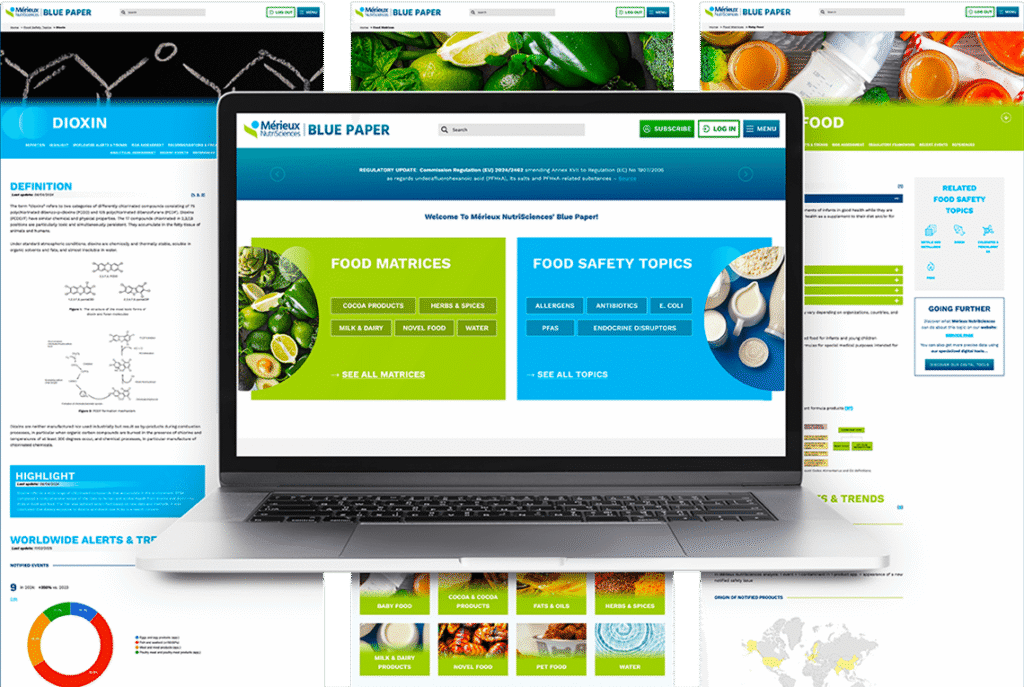
Access exclusive insights from our PFAS experts on the Blue Paper platform, including analyses of food safety, quality and sustainability trends and regulatory updates.