Fresh Produce Food Safety: Anticipating Quality and Compliance from origin and getting Sustainability insights
Fresh produce sits at a unique crossroads in food safety: while vital for human health and nutrition, it is also highly exposed to contamination. As global demand for fresh and minimally processed produce grows, supply chains face mounting pressure to prove safety at speed. For importers and retailers, relying on a static compliance checklist or destination testing is no longer sufficient. Organizations must transition to predictive, data-driven risk management to maintain market access and protect brand integrity.
Worldwide alert trends
Fruits and vegetables are the primary dietary route for human exposure to pesticide residues. According to Safety HUD alerts, the category saw 3,380 notified safety events worldwide in 2025, a 1% increase from 2024.
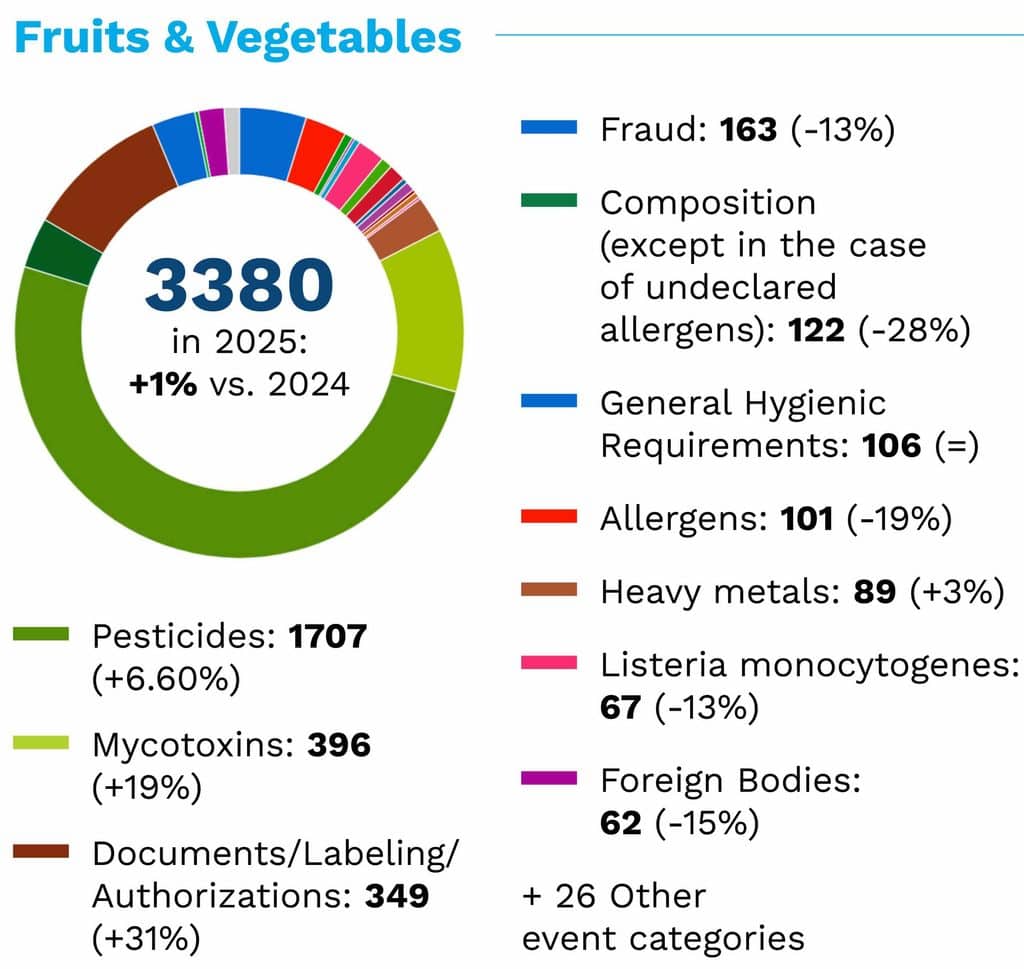
Source: Mérieux NutriSciences Safety HUD and Blue Paper
- The Chemical Threat: Pesticides remain one of the most heavily regulated and frequently monitored hazard categories globally, generating 3,202 alerts across all food categories in 2025 (Safety HUD). In fresh produce, pesticide residues are the #1 RASFF issue, often involving multiple residues (e.g., chlorpyrifos, acetamiprid, dimethoate) on a single product.
- The Microbiological Threat: The 2025–2026 biennium has been defined by the persistence of environmental pathogens. Cold-adapted Listeria monocytogenes strains are emerging in frozen-vegetable (IQF) plants, while Whole Genome Sequencing (WGS) has revealed that bacterial strains can establish survival niches in processing machinery for over two years, resisting conventional sanitation.
2025-2026 Global regulatory changes affecting fresh produce compliance
The global regulatory landscape is tightening structurally. Importers need a live view of where regulations and enforcement are moving. Key regulatory milestones include:
- European Union (August 2026): The EU is tightening regulations through its 2026–2028 Multiannual Pesticide Control Programme, featuring continuous MRL updates and active phase-outs, such as Commission Regulation (EU) 2026/215 restricting dimoxystrobin, ethephon, and propamocarb MRLs by August 19, 2026.
- China (March 2026): The GB 2763-2026 standard enters into force, establishing 10,749 Maximum Residue Limits (MRLs) for 585 pesticides, the most comprehensive iteration to date. Additionally, a new MARA requirement mandates traceability certificates for F&V leaving the farm.
- France (February 2026): The implementation of an emergency ban on imports of foodstuffs from non-EU countries containing quantifiable residues of 5 EU-prohibited substances (including mancozeb and carbendazim).
- United States (2025-2026): The FSMA Agricultural Water Final Rule reinforces a systems-based approach, requiring annual microbial surveys to mitigate recurring E. coli outbreaks linked to irrigation water.
Why Multi-Residue Testing Matters for Fresh Produce
Unexpected detections can occur anywhere, from soil and agrochemicals to cross-contamination on harvest containers. The analytical challenge is immense: laboratories must precisely quantify hundreds of chemically diverse active substances, ranging from highly polar to apolar compounds. Meeting these evolving global standards requires combining core multi-pesticide methods (e.g., QuEChERS LC-MS/MS) with dedicated single-residue methods for highly polar molecules.
Turn Knowledge into Strategy with the Blue Paper
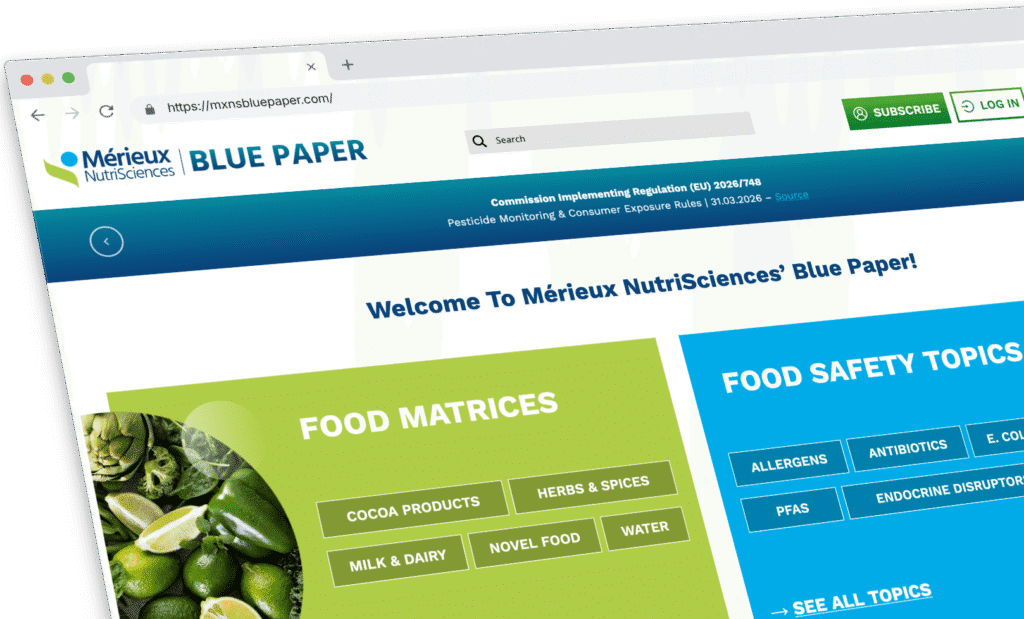
Stop reacting to border detentions and anticipate risks with verified data. The Blue Paper is a comprehensive reference platform developed by over 120 Mérieux NutriSciences experts to analyze global food safety, quality, and sustainability trends.
Mérieux NutriSciences Trusted Solutions for Fresh Produce
Our approach helps exporters, importers, and retailers to secure market access, reduce re-testing and border risks, anticipate compliance and quality challenges, and support sustainable sourcing decisions.
Starting in the Field
- Pesticide Management & Sampling Advice
- Fertilization Guidance
- GlobalGAP Audits
Supporting Global Trade
- Import/Export Compliance
- Packaging and FCM Assessment
- Food Safety Audits
Sustainability Solutions
- Environmental Footprinting & LCA
- Primary Farm Data & Impact Modelling
- Regenerative Agriculture Impact Assessment
Uncompromised Quality & Global Reach
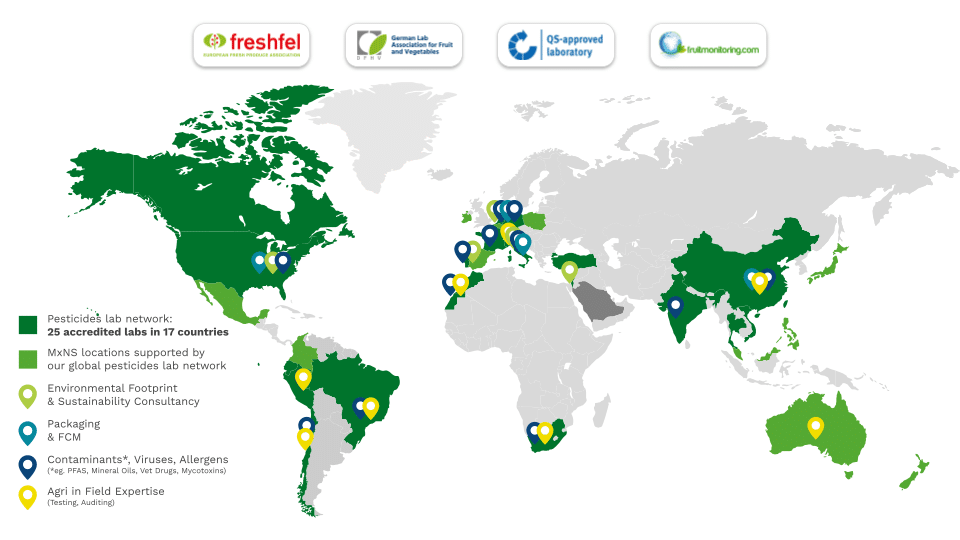
- One Global Quality System: Across a global network of 140+ accredited labs in 32 countries.
- Pesticide Excellence: 25 accredited pesticide labs across 17 countries.
- Retailer Alignment: As a QS-approved laboratory and a participant in fruitmonitoring.com, our data is trusted by major European retailers.
- Sustainability: Environmental Footprinting, LCA, and Regenerative Agriculture Impact Assessments, leveraging primary farm data.