Sensory and Consumer Science: Driving a Sense of Impact at EuroSense 2026

From September 8th–11th, experts from around the world gathered in Oslo, Norway, for EuroSense 2026, the 12th European Conference on Sensory and Consumer Research. This year’s central theme, “A Sense of Impact,” served as a rigorous call to action for the industry to move beyond academic metrics and evaluate how our work fundamentally improves the world.
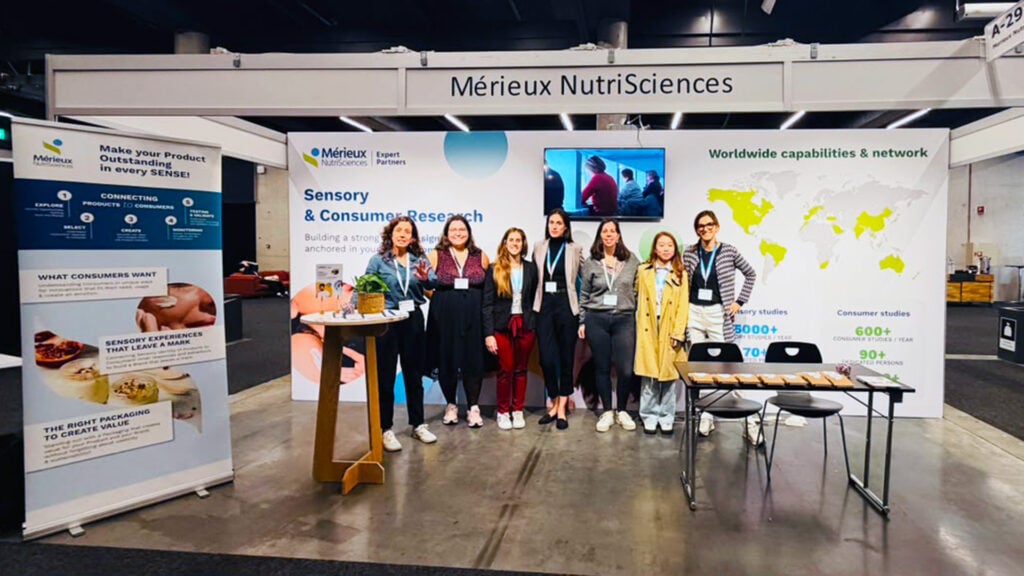
Representing Mérieux NutriSciences on this international stage was a dedicated delegation of experts from across our global network: Monica Borgogno, Claudia Rorandelli, Dolors Santos, Claire Quinton, Sonia Da Silva, and Chenming Zhang. Bringing together diverse technical perspectives and regional insights, our cross-border team actively contributed through poster presentations, interactive workshops, and collaborative exchanges.
Here is a look back at our team’s key takeaways, highlights, and moments from this year’s EuroSense.
Workshops: Redefining the Boundaries of Sensory Science at EuroSense 2026
Defining and Measuring Impact in Sensory and Consumer Science
In partnership with the European Sensory Network (ESN), Monica Borgogno of Mérieux NutriSciences Italy co-led an impactful workshop dedicated to rethinking how value is measured in sensory and consumer science. The session emphasized that research impact must extend far beyond traditional academic metrics, such as citation counts and journal impact factors, to deliver tangible, real-world benefits that meaningfully influence individuals, systems, and global environments.
The workshop framed research impact as a multifaceted driver of value across eight core domains: Academic, Industry, Health & Well-being, Societal, Economic, Environmental, Policy, and Engagement.
To evaluate these outcomes effectively, workshop leaders introduced the foundational triad of Scientific Excellence:
- Scientific Quality: Methodological rigor and novelty.
- Translation into Practice: Active stakeholder engagement and real-world implementation.
- Demonstrable Impact: Quantifiable, meaningful, and lasting change.
To demonstrate how this triad operates in practice, the workshop featured four real-world case studies:
- Health & Well-being: Combining clinical olfactory training with immersive multisensory digital platforms was shown to significantly boost adherence and enhance cognitive-sensory benefits in older adults.
- Environmental Sustainability: Fragrance research proved that eco-friendly ingredients can reach consumer parity or preference while upholding high quality standards through rigorous sensory evaluation.
- Economic Impact: A cafeteria field study examined the discrepancy between initial product liking and repeat purchases, demonstrating that sensory liking scores alone do not ensure long-term repeat buying behavior.
- Social Inclusion: Programs such as Visually Impaired Panelists (VIP) sensory panels illustrated how integrating blind and visually impaired individuals as trained experts fosters workplace innovation and delivers strong societal value.
Discussions and insights gathered from a broader community survey underlined a clear consensus across the field: sensory and consumer science must prioritize addressing real-world challenges, enhancing transparency, and achieving tangible outcomes over relying solely on publication metrics.
Better Nose, Better Health: Improving Smell Training through Sensory and Consumer Science
Loss of smell can severely diminish quality of life, stripping away what is often described as the “silent flavor” of existence. Fortunately, research shows that systematically exposing the nose to target scents helps rebuild damaged neural pathways—acting, quite literally, as physiotherapy for the brain.
Over the past years, the ESN team worked tirelessly to translate this concept into a practical, high-impact training method.
To maximize therapeutic impact, the ESN team developed an innovative training protocol pairing scent inhalation with custom audio-visual content. Merging rigorous scientific methodology with a creative, artistic approach, the prototype was presented live during the session, allowing participants to test the experience firsthand.
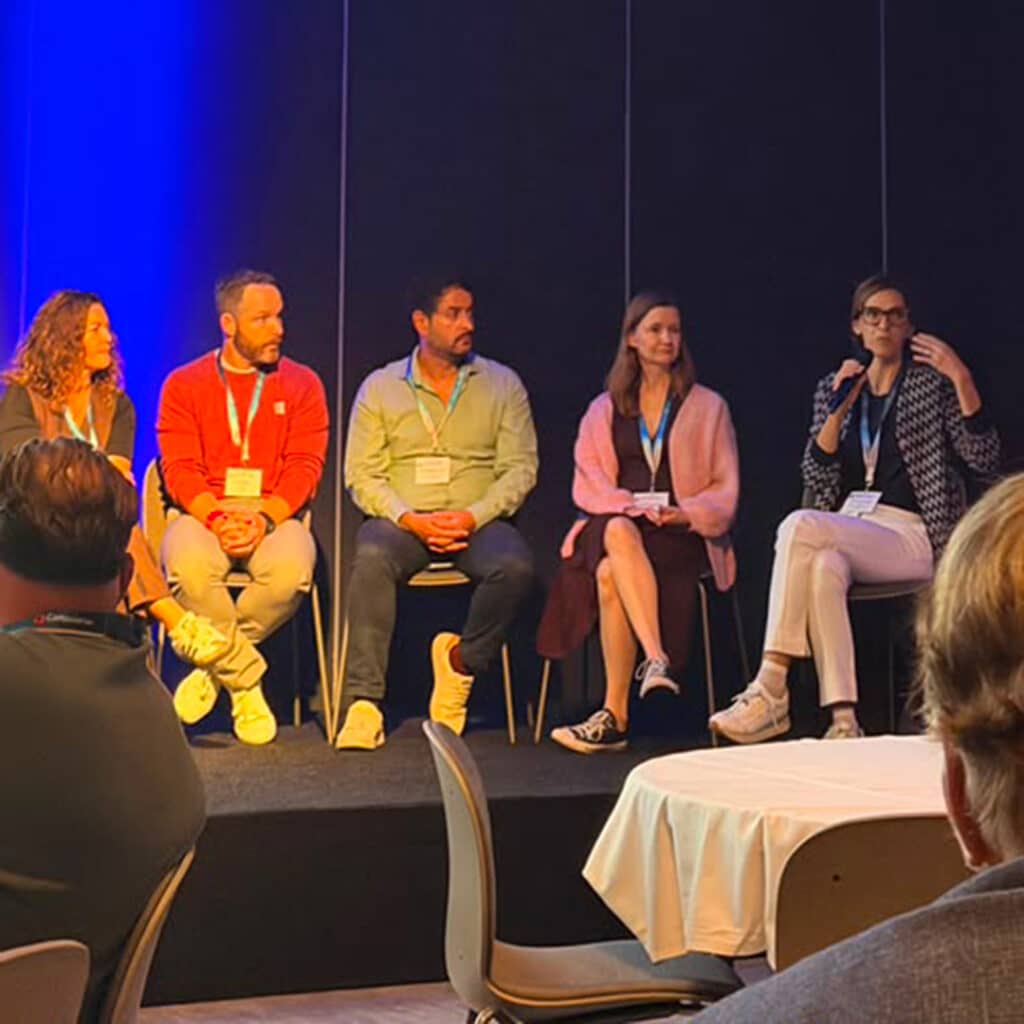
Data from initial pilot studies yielded highly encouraging results, showing strong participant engagement along with promising indicators of training efficacy.
In a key initiative led by the European Sensory Network (ESN) team, in which MxNS’ Dolors Santos and Monica Borgogno were actively involved, workshop participants explored groundbreaking developments in multisensory training designed to address olfactory dysfunction in older adults.
Expanding Our Sense of Impact: Methodologies, Community, and Society Beyond Food
Sensory science originally emerged in the 1950s within food science. Over the decades, its scope has expanded dramatically—evolving from a basic tool for product quality control into a strategic driver of innovation and sustainable development. Today, sensory methodologies extend far beyond food, playing a vital role in sectors like personal care, household care, sporting goods, transportation, and pharmaceuticals.
Despite this rapid expansion, sensory science remains heavily anchored in food-centric paradigms. While non-food applications have advanced quickly, they have done so without the structured frameworks and clear boundaries needed for such diverse product categories. Furthermore, treating non-food applications as isolated sessions at industry conferences has artificially divided the discipline rather than building meaningful bridges.
Adopting a more inclusive perspective could accelerate the entire field. The food and non-food sectors have significant insights to offer one another. By considering the full spectrum of daily human sensory experiences across every product category, the industry can unlock brand-new methodologies and insights.
To address this shift, the workshop explored three central questions:
- Structural Evolution: Should the “beyond-food” sensory domain grow organically within existing food-centered structures, or evolve as a distinct, parallel field?
- Systemic Adaptation: What structural, methodological, and educational changes are required to support its broader adoption?
- Global Impact: How can research outputs contribute directly to sustainability, innovation, and the 2030 Sustainable Development Goals (SDGs) for “people, planet, and prosperity”?
As part of the European Sensory Science Society (E3S) “Beyond Food” Working Group, Monica Borgogno moderated a key session debating whether non-food sensory research should remain embedded in existing food-focused structures or forge its own path.
During the debate, participants highlighted several critical hurdles currently facing the industry:
- Standardization Gaps: A lack of established international standards specifically tailored to non-food product categories.
- Contextual Testing Logistics: The operational complexity of assessing product performance in authentic, real-world environments, such as home bathrooms or laundry rooms.
Advanced Research in Sensory & Consumer Science: Poster Presentations and Research
Throughout the four days of EuroSense 2026, scientific contributions took center stage for Mérieux NutriSciences.
Our team was proud to showcase our latest research in sensory and consumer science through a series of poster presentations on display across the entire event.
1. Data Communication and Multivariate Complexity
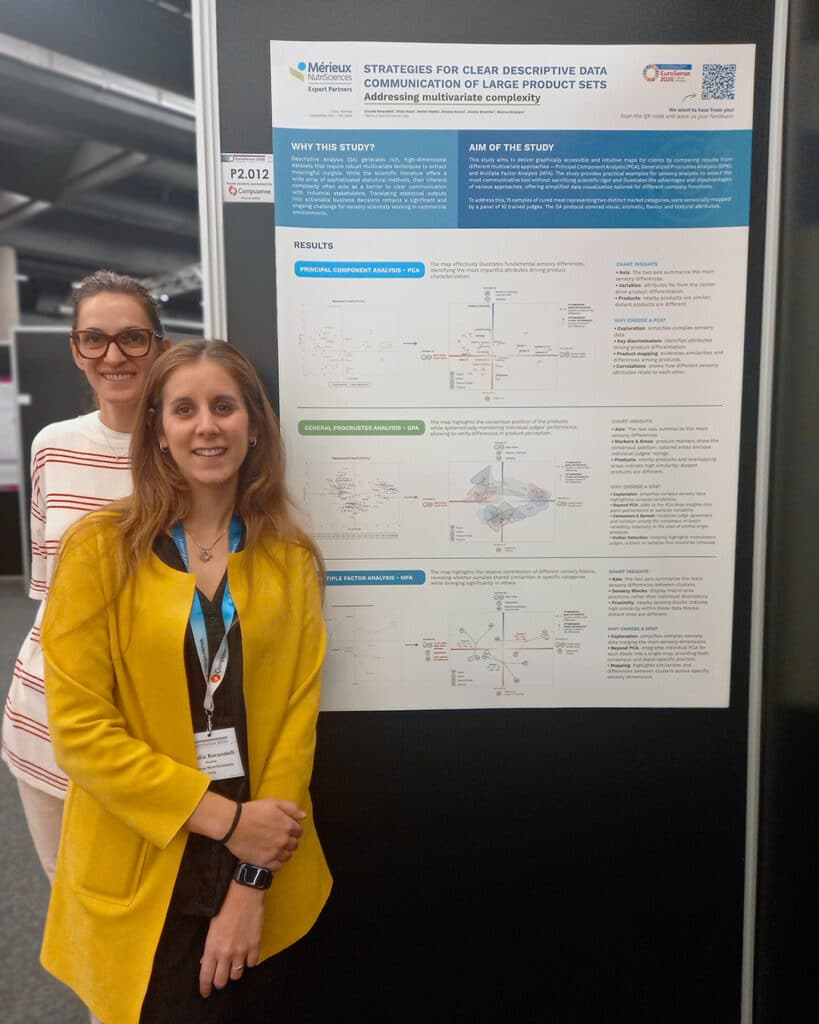
Effective research requires the clear translation of complex data. The poster “Strategies for clear descriptive data communication regarding large product sets (Addressing multivariate complexity), detailed methodologies for making high-dimensional datasets actionable for business stakeholders.
2. Coffee Secondary Shelf Life
Mérieux NutriScience’s team also presented “SECONDARY SHELF LIFE OF GROUND COFFEE: Different sensory methods for cut-off identification,” in collaboration with the University of Florence and Lavazza; the study compares varied sensory techniques to identify exactly when quality declines after a product’s primary seal is broken.
3. Ecological Sensitivity in Consumer Targeting
Addressing the shift toward green consumption, in the work titled “TARGETING CONSUMERS BASED ON ECOLOGICAL SENSITIVITY”, the team utilized an agile digital approach, using a U&A questionnaire of 61 questions to decode complex consumer behaviors in a high-throughput environment.
By using the random forest method, the study reduced the questionnaire, providing a rapid, scalable method for identifying the level of eco-sensitivity of consumers.
4. The Beauty Purchase Experience and Cosmetic Labels
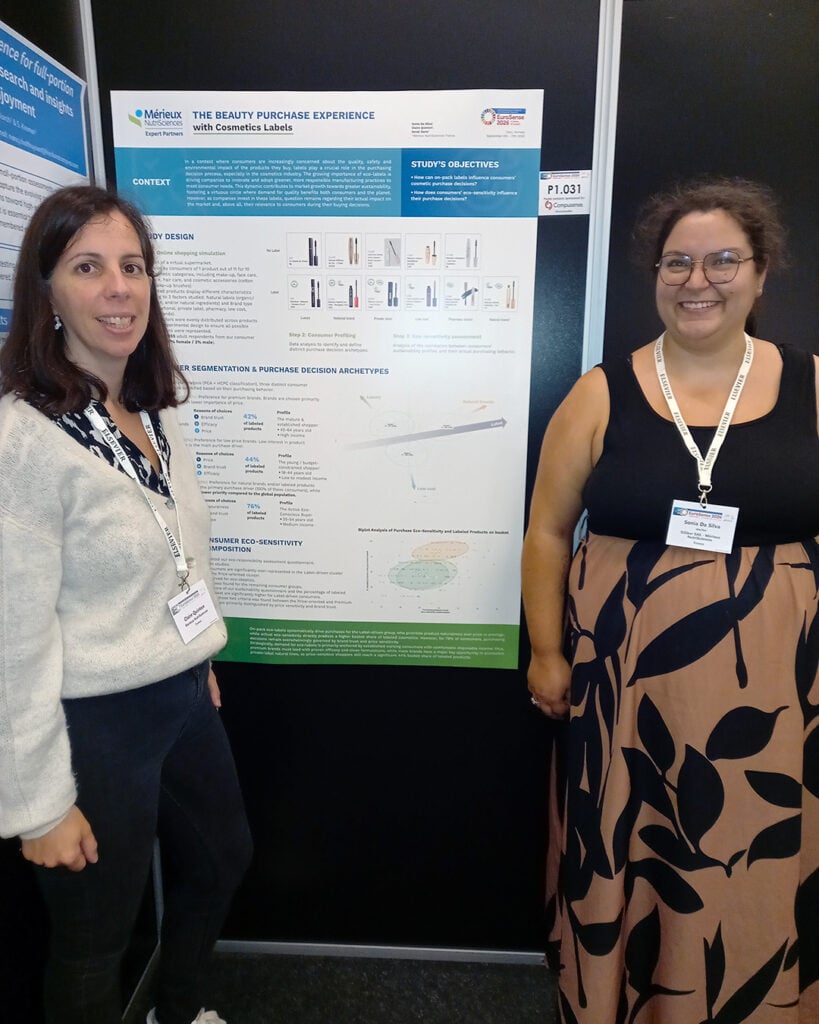
Furthering the investigation into sustainability, the delegates presented findings on how on-pack labels influence market decisions.
The team utilized a virtual supermarket simulations to decode complex consumer behaviors in a high-throughput environment.
By simulating “real-world” shopping friction, the study provided a rapid, scalable method for identifying the criteria that influence choices across 10 cosmetic categories.Using PCA and HCPC multivariate analysis, the study identified three distinct consumer archetypes:
- Premium Choices (44%): Driven by brand trust and efficacy; these “mature” shoppers prioritize quality over price.
- Price Oriented (35%): Driven by cost; this group shows very low interest in naturalness or organic labels.
- Natural & Health Seekers: A segment highly influenced by eco-labels (organic, vegan) and pharmacy brand trust, prioritizing the virtuous circle of quality for both themselves and the planet.
5. Implicit test applied to cosmetics
A highly innovative contribution to the cosmetic sector was showcased in the presentation “A touch of emotions: implicit emotional profiling of cosmetic cream across texture variations,” authored by Monica Borgogno in collaboration with the SensoryLab at the University of Florence. The research evaluated how the tactile sensation of skin cream textures directly triggers automatic, implicit emotional responses in consumers. Utilizing the e-Affective Misattribution Procedure, the study demonstrated that cosmetic cream textures alone elicit distinct emotional reactions. These insights offer valuable guidance for R&D and marketing teams in developing consumer-centric product designs.
Conclusion: Shaping the Future of Sensory Science and its Impact
The industry is shifting from traditional academic metrics toward a “real-world” impact model that bridges scientific rigor with human-centric design.
Looking ahead, EuroSense 2026 underscored how artificial intelligence and synthetic data are swiftly revolutionizing sensory and consumer research. Discussions across the conference highlighted the key role of AI tools and synthetic personas in augmenting traditional consumer panels, raising crucial questions such as: how does the path forward looks like, and, will AI ultimately dictate human preferences and desires, or will it preserve authentic human choice in the process?
As we return from Oslo inspired by these forward-thinking exchanges, our team is energized to turn these discussions into practical, high-impact solutions for your next product innovation. Thank you to everyone who visited our booth, engaged with our researchers, and shared ideas with us. We look forward to shaping the next frontier of sensory science together!