Climate Change: An Amplifier of Food Safety Risks
When people think about climate change, they often picture melting glaciers, rising sea levels, or extreme weather events. While these impacts are undeniably important, another growing concern is receiving increasing attention from food safety authorities worldwide: the impact of climate change on the safety of our food.
Climate change is reshaping the conditions under which food is produced, processed, stored, transported, and consumed. Rising temperatures, shifting rainfall patterns, ocean warming, and more frequent extreme weather events are creating new pathways for food contamination while amplifying existing food safety hazards. As a result, climate change is emerging as a major driver of biological, chemical, and environmental risks throughout the food chain.
Food safety has traditionally focused on issues such as bacterial contamination, improper handling, and chemical residues. Today, climate change is amplifying many of these risks by altering the ecology and distribution of hazards, increasing contamination pathways, and disrupting food production systems.
Rising Temperatures: A Catalyst for Foodborne Hazards
Among the many effects of climate change, increasing temperatures are one of the most significant drivers of food safety risks.
Increased Growth and Spread of Foodborne Pathogens
Warmer conditions accelerate the growth, survival, and transmission of many foodborne pathogens, including Salmonella, Campylobacter, Escherichia coli, Listeria monocytogenes, and Vibrio species. Higher temperatures can also expand the geographic range of these microorganisms, increasing the likelihood of contamination and foodborne disease outbreaks.
At the same time, heatwaves and elevated ambient temperatures place additional pressure on refrigeration systems and cold-chain infrastructure. Even short disruptions during storage or transportation can significantly increase the risk of food spoilage and pathogen growth.
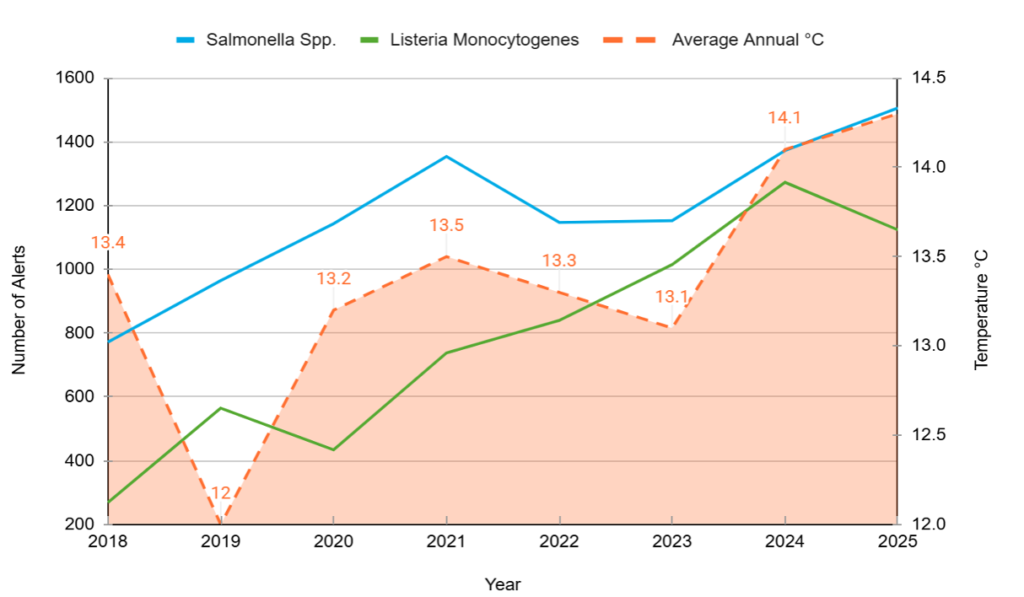
Relationship between rising temperatures and the incidence of Listeria monocytogenes and Salmonella spp. food safety alerts (2018-2025).
Sources: (Mérieux NutriSciences safety Hud, 2026); (National Weather Service, n.d.); (Copernicus Marine Service, 2025)
Ocean Warming and Marine Food Safety Risks
Climate change is transforming marine ecosystems. Rising sea surface temperatures and changes in acidity level favor the proliferation of harmful algal blooms (HABs). These blooms produce marine biotoxins that accumulate in shellfish and seafood, potentially causing severe food poisoning incidents in consumers.
As oceans continue to warm, harmful algal blooms are expected to become more frequent, longer-lasting, and more geographically widespread, creating new challenges for seafood safety monitoring programs.
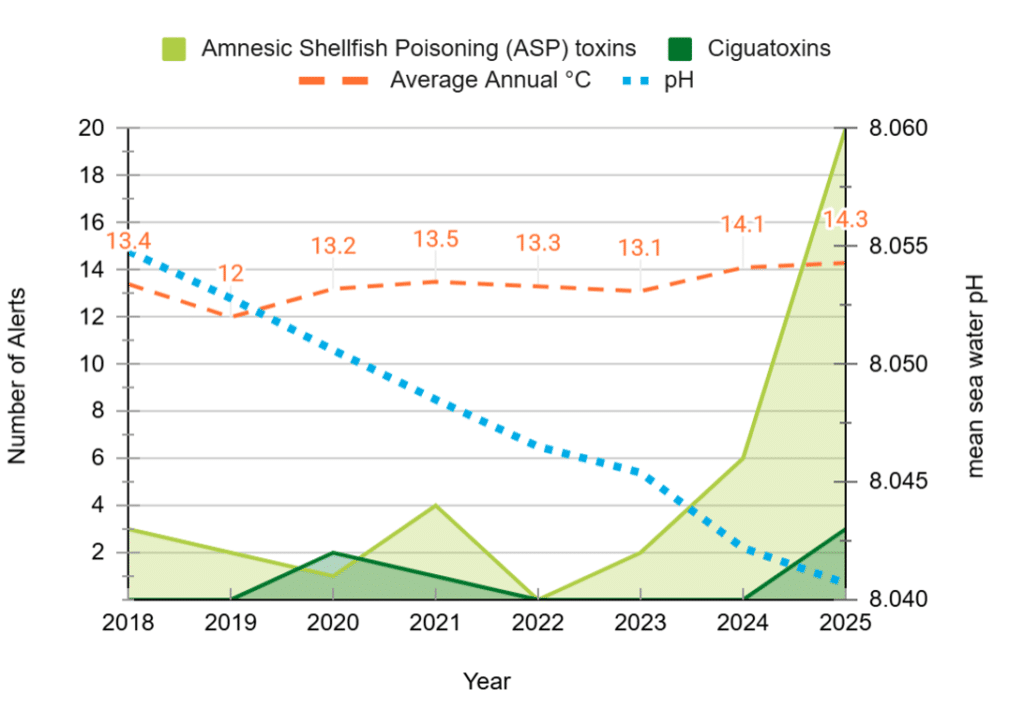
Relationship between rising temperatures, ocean acidification, and the increase of Amnesic Shellfish Poisoning (ASP) and Ciguatoxin alerts (2018-2025).
Sources: (Mérieux NutriSciences safety Hud, 2026); (National Weather Service, n.d.); (Copernicus Marine Service, 2025)
Increased Mycotoxin Contamination
Changes in temperature, humidity, and rainfall patterns also influence the growth of toxin-producing fungi. Crops such as maize, wheat, rice, nuts, and animal feed are becoming increasingly vulnerable to contamination by mycotoxins including aflatoxins, fumonisins, deoxynivalenol (DON), ochratoxin A, and zearalenone.
These toxins are associated with serious health effects ranging from immune suppression and growth impairment to liver cancer. Climate change is already contributing to shifts in fungal populations and the appearance of mycotoxin risks in regions previously considered low risk.
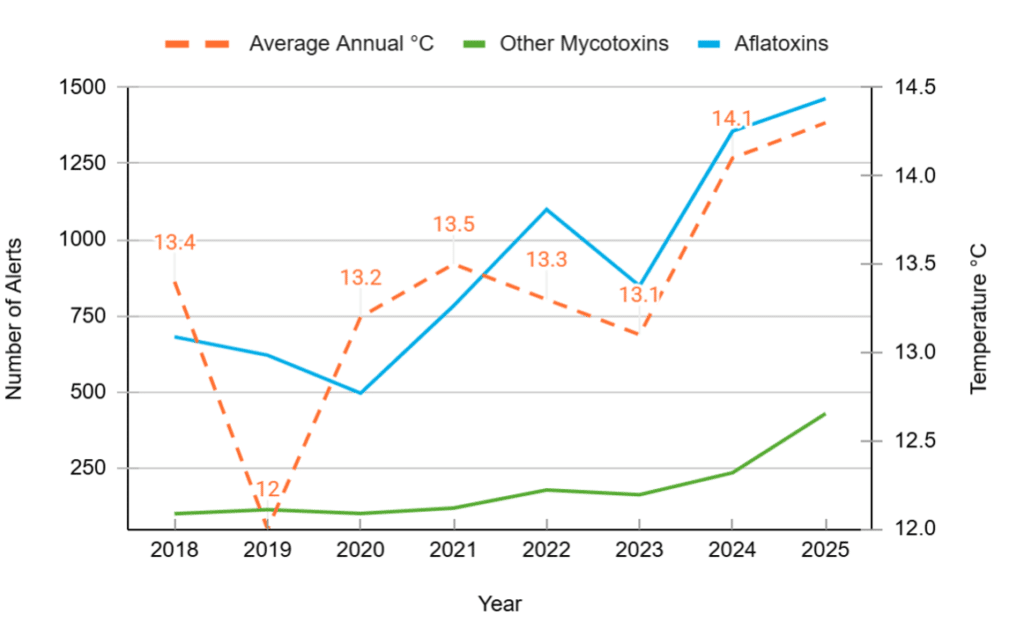
Impact of rising temperatures on the proliferation of toxic fungal pathogens and the resulting increase in mycotoxin occurrence (2018-2025).
Sources: (Mérieux NutriSciences safety Hud, 2026); (National Weather Service, n.d.); (Copernicus Marine Service, 2025)
Extreme Weather Events: Creating New Contamination Pathways
Climate change is increasing the frequency and intensity of floods, droughts, storms, and heatwaves. Beyond their direct impacts on agricultural productivity, these events create multiple opportunities for food contamination.
Flooding and Contaminated Runoff
Heavy rainfall and flooding can transport pathogens, untreated sewage, industrial pollutants, pesticides, and heavy metals into agricultural land, irrigation systems, and aquaculture environments. Fresh produce consumed raw is particularly vulnerable to contamination.
Flooding can also increase contamination of shellfish harvesting areas through sewage overflows, resulting in the introduction of enteric pathogens such as norovirus, hepatitis A virus, Salmonella, and pathogenic E. coli into the food chain.
Drought, Water Scarcity, and Water Quality Degradation
Water scarcity is becoming a major food safety concern. Prolonged droughts reduce the availability of clean water for irrigation, livestock production, cleaning operations, and food processing.
As freshwater resources become increasingly limited, producers may rely on alternative water sources of lower microbiological quality, increasing the risk of contamination. Water shortages can also disrupt food manufacturing operations and compromise hygiene practices throughout the production chain.
Supply Chain and Cold-Chain Disruptions
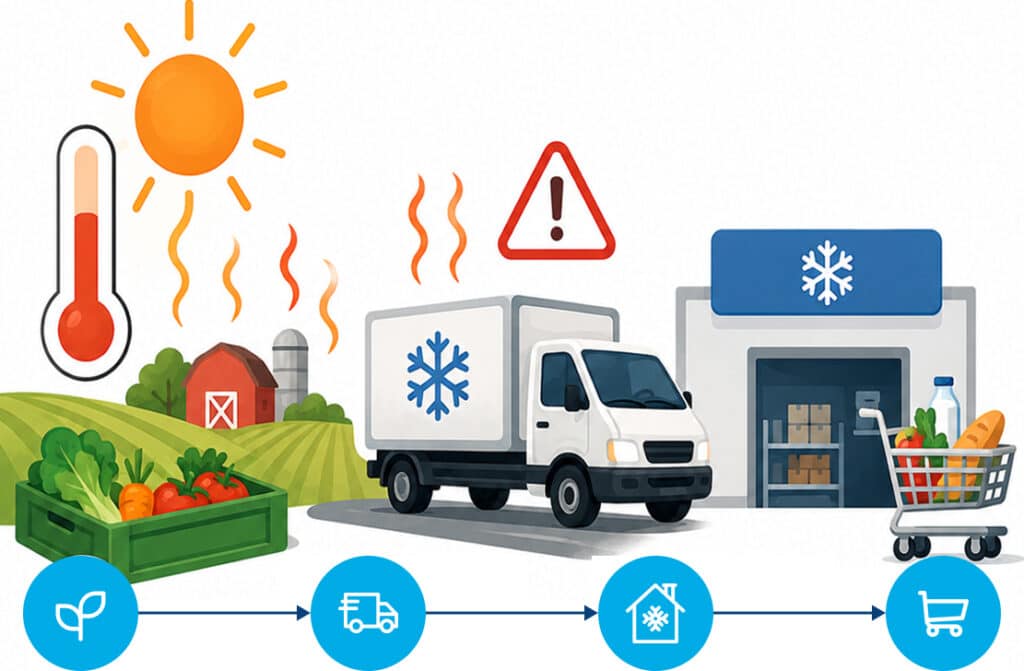
Extreme weather events can damage infrastructure, interrupt transportation routes, and cause power outages. These disruptions increase the likelihood of temperature abuse during food storage and distribution, reducing shelf life and increasing spoilage and contamination risks.
In a globalized food system, a climate-related disruption in one region can rapidly affect food safety and availability across multiple countries.
Climate Change and Chemical Food Safety Risks
While microbiological hazards often receive the most attention, climate change is also influencing chemical risks in food.
Increased Pesticide Residues
Rising temperatures and changing environmental conditions are contributing to the expansion of agricultural pests, plant diseases, and invasive species. To maintain crop yields, farmers may increase the use of pesticides and fertilizers.
Although these interventions help protect food production, they may also increase pesticide residue levels in food and the surrounding environment if not carefully managed.
Heavy Metals and Environmental Contaminants
Flooding, soil erosion, industrial runoff, and changes in aquatic ecosystems can alter the distribution and bioavailability of environmental contaminants such as mercury, cadmium, lead, arsenic, and persistent organic pollutants (POPs).
These contaminants can accumulate in crops, livestock, and seafood, creating long-term food safety concerns and increasing human exposure through the diet.
Antimicrobial Resistance: An Emerging Concern
Climate change may indirectly contribute to the spread of antimicrobial resistance (AMR). Increased climate change related stress in livestock and aquaculture systems can lead to greater antimicrobial use, while flooding and environmental contamination can facilitate the dissemination of resistant microorganisms.
The spread of AMR represents a growing public health challenge, reducing the effectiveness of treatments for foodborne infections and increasing the burden of disease.
Climate Adaptation: Balancing Resilience and Food Safety
As farmers and food producers adapt to changing climatic conditions, some adaptation measures may introduce new food safety considerations.
The adoption of new crop varieties, alternative protein sources, water reuse systems, controlled-environment agriculture, and emerging food production technologies can support resilience and sustainability. However, these innovations may also require careful assessment of microbiological, chemical, and allergenic risks.
Effective adaptation therefore depends not only on maintaining food production but also on ensuring that food remains safe for consumers.
Building a Climate-Resilient Food System
Addressing climate-related food safety challenges requires action across the entire food chain.
Governments can strengthen food safety regulations, climate surveillance programs, and early-warning systems. Researchers can develop predictive models, rapid detection methods, and climate based risk assessment tools. Food businesses can invest in resilient supply chains, robust cold-chain management, responsible water use programs, and preventive food safety systems. Producers can adopt sustainable agricultural practices that protect both productivity and food safety.
International collaboration will be essential. Climate change does not recognize national borders, and neither do food safety hazards. Protecting the safety of the global food supply will require coordinated efforts among governments, scientists, industry stakeholders, and consumers.
Climate change is no longer only an environmental issue, it is increasingly a food safety issue. Understanding and addressing these emerging risks will be critical to ensuring that future food systems remain not only productive, but also safe, sustainable, and resilient.