Food products are designated as Novel Food when they have not historically been consumed in the country where we intend to commercialize them. This results in a specific regulation and pre-market authorization process in many areas of the world.
Europe & Novel Food Products
The Regulation (EU) 2015/2283 governs novel food products in Europe. It became applicable from 2018, replacing an earlier European regulation dating back to 1997. Similar regulations apply in other regions worldwide (see section on Novel food regulations outside EU).
The European Commission employs this regulation to ensure consumer safety and evaluate the product’s applications and benefits before granting market authorization. The European Food Safety Authority (EFSA) handles the risk assessment and scientific outputs.
For instance, if a product aims to replace meat, it undergoes evaluation to determine if it provides similar or superior nutritional values and benefits for consumers’ health.
This regulation applies to food products that were not significantly consumed by humans in the EU before 15 May 1997, when the first Regulation (EC) No 258/97 on novel food came into force.

Examples of Novel Foods
- New ingredients derived from krill oil, rich in omega-3 fatty acids
- Edible insects used used as animal protein alternative
- Plant sterols used as new ingredients
- Nanotechnology used as a new way of producing food

Novel Food Regulations Outside the EU
How to get Novel Foods Approved in Europe?
In Europe, the European Food Safety Authority (EFSA) is responsible for conducting the risk assessment of novel food products, based on a dossier submitted by applicants. This process can be lengthy and intricate. To expedite approval and market entry, the dossier must be meticulously prepared, addressing all of EFSA’s requirements comprehensively.
We can summarize this process in three steps:

Mérieux NutriSciences provides comprehensive support to the Novel Food Industry at every stage of the supply chain

How can we Help?
Mérieux Nutrisciences provides support to food, ingredients, and pharmaceutical companies seeking to market products falling under the novel food regulation.
Our experts commence with a preliminary assessment to determine if the product qualifies as a novel food and to construct a technical dossier in its support.
Subsequently, we can initiate the consultation process, following Regulation (EU) 2018/456.
Promptly, we design the evaluation and experimental plan in accordance with EFSA requirements. This plan mainly encompasses:
- Nutritional information: nutritional characterization and contaminants.
- Composition data: physico-chemical and nanomaterials characterization.
- ADME & Pre-clinical test evaluations.
- Toxicological information: genotoxicity tests.
- Clinical studies.
Our team performs all the analyses outlined in the experimental plan.
Next, we meticulously prepare and submit the dossier. Indeed, we ensure that we fully prepare to address any potential queries or requests from EFSA.
Why Work with Mérieux NutriSciences?
Mérieux NutriSciences’ team has extensive experience supporting numerous food and ingredient companies throughout the Novel Food process, right up to dossier approval. We possess in-depth knowledge of the process, regulations, and requirements involved.
Our team works closely with EFSA to proactively anticipate their questions and stay updated on evolving requirements. This enables us to submit dossiers that are exceptionally comprehensive.
What sets us apart from most companies in this field is our commitment to providing more than just guidance on the process and dossier completion. With our laboratory capabilities and scientific expertise, we supply all the necessary data you require to meet EFSA’s requirements.
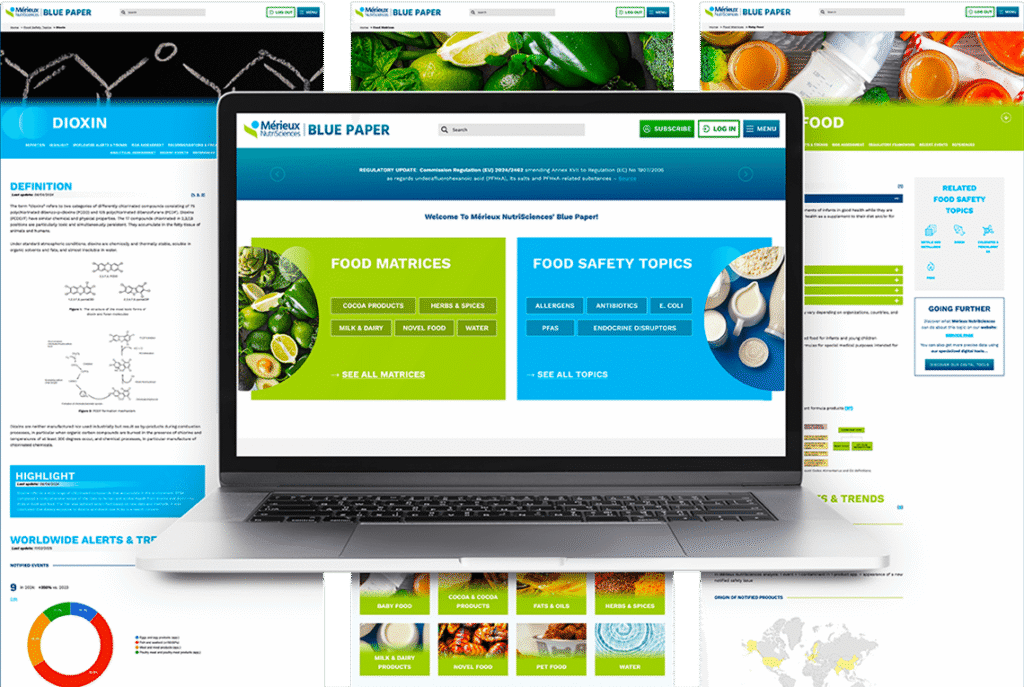
Blue Paper: Novel Food
Access exclusive insights from our Novel Food experts on the Blue Paper platform, including analyses of food safety, quality and sustainability trends and regulatory updates.