

More results...

Dioxins and PCBs in Food
Dioxins and polychlorinated biphenyls (PCBs) are chlorinated compounds persisting in the environment and accumulating throughout the food chain, potentially causing adverse effects on humans.
Dioxin in Food
Dioxins consist of two compound groups:
- Polychlorinated dibenzo dioxins (PCDDs) with 75 congeners.
- Polychlorinated dibenzofurans (PCDFs) with 135 congeners.
Certain thermal and industrial processes generate these compounds as unwanted by-products despite their lack of technological application.
PCBs in Food
Until the 1980s, many countries extensively used PCBs, which comprise 209 congeners, in industrial applications before banning them. They are categorized into dioxin-like and non-dioxin-like PCBs.
Non-dioxin-like PCBs (NDL PCBs) are persistent organic chemicals accumulating in the environment and humans, associated with various health effects. In food, the highest contamination levels occur in fish products, eggs, milk and terrestrial animal meat. In opposition, foods of plant origin show the lowest contamination levels (EFSA Study from 2010). Feed exhibits a similar trend, with higher contamination levels found in fish-derived feed and lower levels in plant or mineral-derived feed.
Dioxins and PCBs in Food: Exposure & Toxicity
Dioxins and PCBs are present at low levels in many food matrices. They are resistant to biological degradation, highly lipophilic, and accumulate in numerous food products, particularly those of animal origin. Their persistence and tendency to accumulate in the food chain, notably in animal fat, continue to raise safety concerns.
Studies on exposure and toxicity of dioxins & PCBS
Regulatory Framework
EU Regulation 2023/915 and Directive 2002/32/EC (amended by Regulation No 277/2012) regulate the presence of dioxins and PCBs in food and feed, setting maximum levels for individual residues and their sums.
The maximum levels apply to 17 PCDD/PCDFs, 12 dioxin-like PCBs, and 6 non-dioxin-like PCB indicators, collectively representing more than half of those typically found in food and feed.
Our Analytical Services for Dioxins & PCBs in the Food Industry
Mérieux NutriSciences provides comprehensive and reliable analytical services fully compliant with current requirements on dioxins and PCBs in food, feed, and environmental matrices.
Our dedicated team offers analytical packages applying official EPA methods via HRGC-HRMS, with results expressed in toxicity factors and TEQ units, calculated using appropriate analytical-toxicological conversion factors.
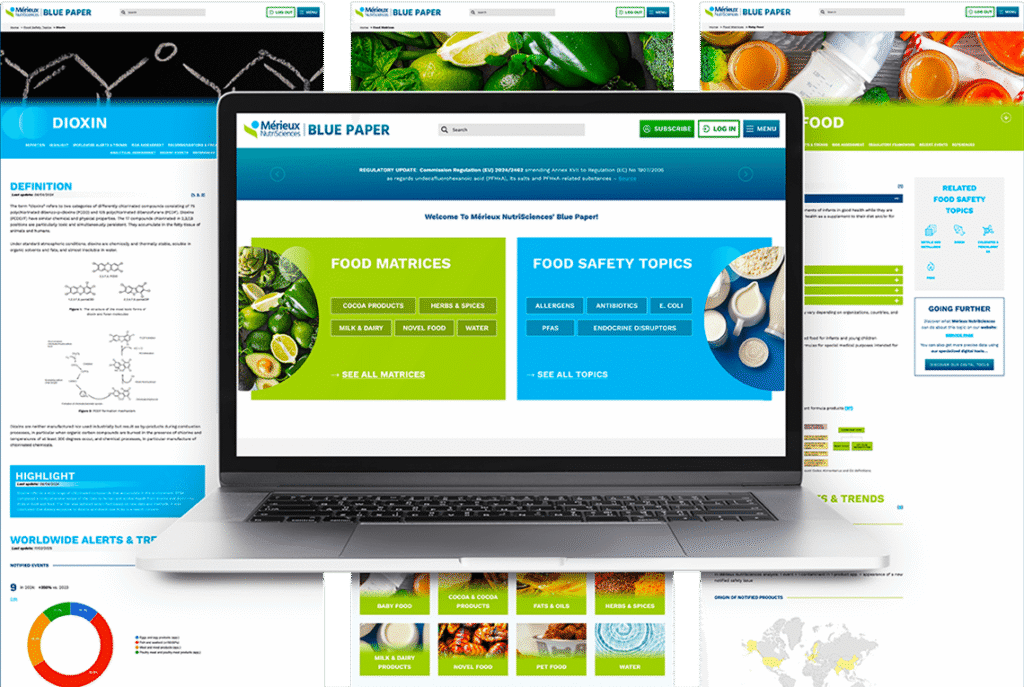
Blue Paper: Dioxins & PCBs
Access exclusive insights from our Dioxins & PCBs experts on the Blue Paper platform, including analyses of food safety, quality and sustainability trends and regulatory updates.
Other Contaminants & Residues


Mérieux NutriSciences Corporation
More results...
© 2025 Mérieux NutriSciences All Rights Reserved – Created by Apollo Studio
Privacy Policy • Legal Notice • Cookie Management